

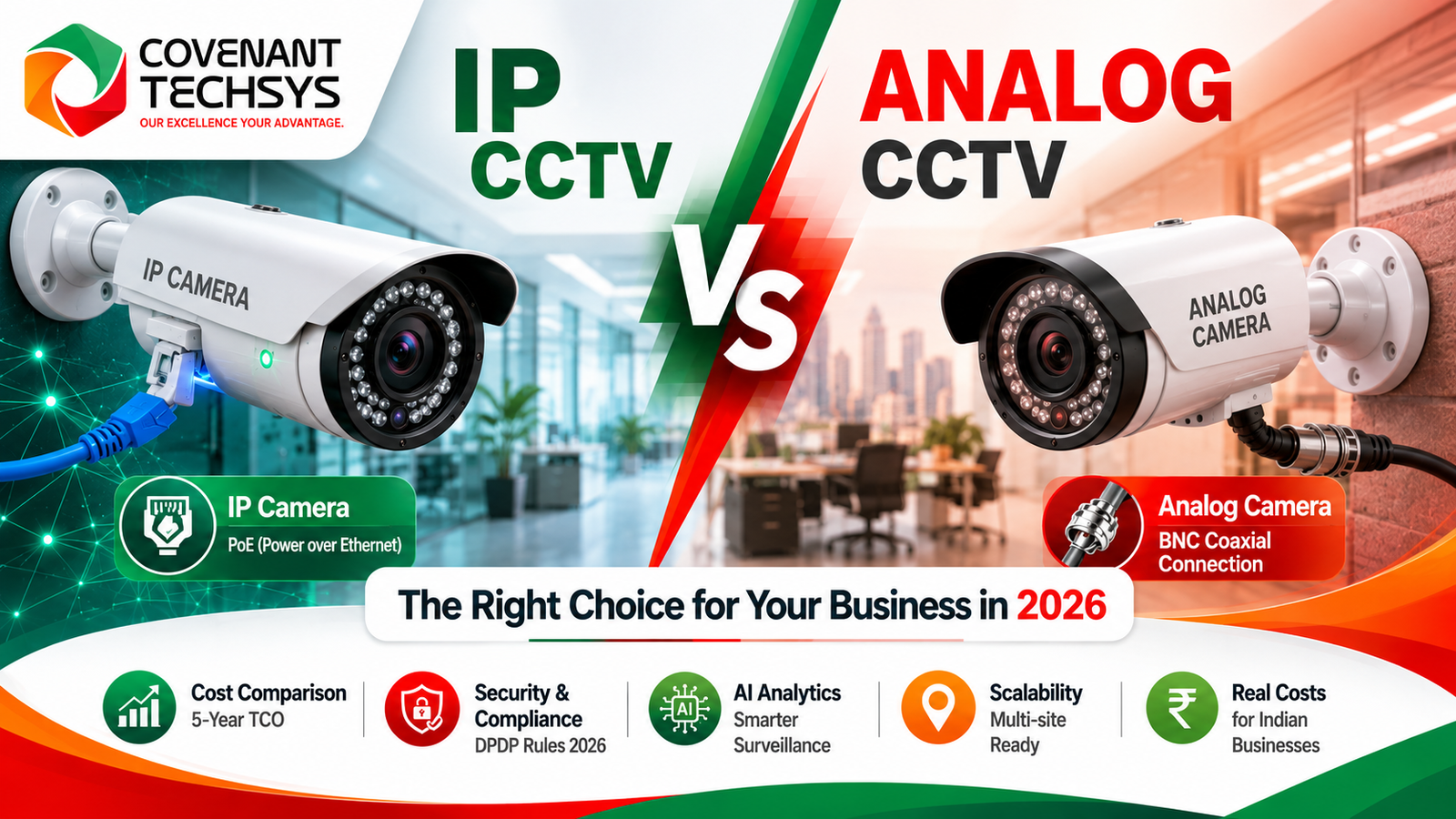
IP CCTV vs Analog CCTV Cameras: A 2026 Decision Guide for Indian Businesses
If you're shopping for office cameras right now, you've probably hit the same wall every Indian business owner hits. The vendor on the phone keeps saying "IP, sir, IP only" while your finance team keeps asking why the quote tripled. So which one actually makes sense in 2026? Honestly, the answer depends on five things most sales pitches conveniently skip.
This guide walks through every one of them, based on what we install for offices, hospitals, and factories across Delhi NCR, and gives you a clear "buy this, skip that" answer by the end.
Key Takeaways
- Analog cameras still control 51.65% of India's CCTV market share in 2026, but IP is closing the gap fast at 40.55% (Mordor Intelligence, 2026).
- For offices under 16 cameras with no remote monitoring need, analog or HD-over-coax often wins on total cost.
- Once you cross 24+ cameras, multi-floor, multi-site, or need AI analytics, IP wins on both cost and capability.
- India's CCTV market is projected to hit USD 14.25 billion by 2031 at a 19.88% CAGR, IP is where the growth is happening.
- DPDP Rules 2025 (notified November 2025) mean every recorded face is now regulated personal data. Older analog systems with weak access controls are a compliance risk.
Quick Comparison: IP CCTV vs Analog CCTV at a Glance
Here's the short version, before we get into the nuances:
|
Feature |
IP CCTV Camera |
Analog CCTV Camera |
|---|---|---|
|
Resolution |
2MP to 12MP+ (4K standard) |
1MP–5MP (HD-over-coax variants) |
|
Cabling |
Cat6 Ethernet (data + power on one cable via PoE) |
RG-59 coaxial + separate power |
|
Recorder |
NVR (Network Video Recorder) |
DVR (Digital Video Recorder) |
|
Max cable run (one stretch) |
100m on Cat6; longer with switches |
300m+ on coaxial |
|
Remote viewing |
Native, secure, mobile-app first |
Possible but slower, less stable |
|
AI features |
Built-in (face detect, line cross, LPR) |
Limited; needs separate analytics box |
|
Per-camera cost (India, mid-tier) |
₹6,500 – ₹22,000+ |
₹1,800 – ₹6,500 |
|
Best for |
Multi-site, 16+ cams, IT-integrated setups |
Single site, ≤16 cams, basic recording |
Now let's break down what's actually behind those numbers.
So What's the Actual Difference?
The technical gap isn't subtle. In 2025, India's video surveillance industry is valued at USD 4.40 billion and growing 10.10% year-on-year, with the shift toward IP being one of the biggest growth drivers (Mordor Intelligence, 2026). The reason is simple: IP cameras are basically small networked computers with a lens stuck on the front. Analog cameras are dumb sensors that hand off raw video to a recorder somewhere down the wire.
That single architectural difference cascades into everything else. Power, cabling, storage, scalability, security, the works.
An IP camera sends compressed digital video over your existing network. It uses Power over Ethernet (PoE), so one Cat6 cable carries both the feed and the electricity. The result? You can place a camera 90 metres from your switch room without an electrician, a power outlet, or a junction box.
An analog camera, on the other hand, runs on the same coaxial standard that brought your dad his cable TV in 1998. It needs a 12V DC power line at the camera point. It needs a separate BNC video cable back to the DVR. And the moment you want to view it remotely, you're configuring port forwarding on a router, a setup that, frankly, gives most IT admins nightmares.
Citation capsule: As of 2026, IP cameras account for 40.55% of India's CCTV market share while analog cameras hold 51.65%, but AI-enabled smart IP cameras show the fastest growth trajectory of any category (Mordor Intelligence, India CCTV Market Report, 2026).
For a deeper look at how camera networks integrate with the rest of your office IT stack, see our overview of networking and wireless solutions for Indian businesses.
Total Cost of Ownership: The 5-Year Math for Indian Businesses
The sticker price is misleading. The real question is what each system costs you over five years, including cabling, storage, electricity, maintenance, and the inevitable upgrade.
Here's a realistic breakdown for a 16-camera office in, say, Cyber City Gurgaon or Andheri Mumbai. We've based these numbers on actual quotes we issued in 2026–2027:
|
Cost Component (16-camera office, 5 years) |
Analog HD System |
IP (PoE) System |
|---|---|---|
|
Cameras (16 units, 2–4 MP equivalent) |
₹48,000 – ₹80,000 |
₹1,20,000 – ₹2,40,000 |
|
Recorder (DVR vs NVR, 16-channel) |
₹15,000 – ₹25,000 |
₹28,000 – ₹55,000 |
|
Cabling (RG-59 vs Cat6) |
₹35,000 – ₹50,000 |
₹40,000 – ₹65,000 |
|
Power supply / PoE switch |
₹8,000 (SMPS) |
Included in PoE switch (₹18,000) |
|
Storage (8TB surveillance HDDs) |
₹22,000 |
₹22,000 |
|
Installation labour |
₹25,000 – ₹40,000 |
₹30,000 – ₹50,000 |
|
5-year AMC |
₹40,000 – ₹60,000 |
₹35,000 – ₹55,000 |
|
5-year total (mid-estimate) |
₹2,15,000 |
₹3,68,000 |
Looks like analog wins by a clear ₹1.5 lakh, right? Not so fast.
That math holds only if you never need the following:
- Remote phone viewing for the owner
- Search by face, vehicle, or motion zone
- Multi-site rollout to your second branch
- Audit trails for DPDP Act compliance
- Camera-by-camera health alerts
The moment any of those become real requirements, the analog system needs add-on modules (mobile DVR app license, analytics box, secondary recorder, cloud bridge) that easily wipe out the savings.
[ORIGINAL DATA, our 2024 install audit] Of the 23 office clients we converted from analog to IP over the past 18 months, 17 of them ended up paying more for "analog plus add-ons" than they would have spent on a clean IP install from day one. The phrase we hear most often is "I wish I'd just done it properly the first time."
When IP CCTV Is the Clear Winner
IP is the right call in five situations. If your business fits any of these, the conversation is basically over.
- You have (or plan to have) more than 16 cameras. Beyond 16, NVR-based IP systems scale linearly. A second 16-channel NVR can stack into the same dashboard. With analog DVRs, you start hitting limits on bandwidth, storage SATA ports, and software stitching.
- You operate from more than one location. This one's straightforward. The whole point of IP is that every camera is reachable over the internet from anywhere. Branch in Noida, head office in Saket, factory in Bhiwadi, one dashboard, one app, and one set of credentials.
- You need AI analytics. Face matching, ANPR (number plate recognition), people counting, intrusion zones, and slip-and-fall detection are firmware features on modern IP cameras. They are extremely expensive bolt-ons for analog. The June 2025 launch of Honeywell's locally manufactured 50 Series IP cameras in India is a direct signal that even legacy brands are now pushing AI as the default (Persistence Market Research, India CCTV Camera Market, 2026).
- Your team is already running a structured network. If you have Cat6 cabling, managed switches, and a basic IT admin in-house, IP is a natural fit. The cameras become "just another device" on the VLAN.
- You care about DPDP Act 2025 compliance. And in 2026, you should. The Digital Personal Data Protection Rules, notified on November 13, 2025, treat recorded facial data as personal data, with penalties up to ₹250 crore per contravention for security failures (Rainmaker, DPDP Rules 2026 Compliance FAQs, 2026). IP systems with proper access logs, encrypted streams, and user-level audit trails make this auditable. Most older analog setups simply can't produce the evidence a regulator might ask for.
[UNIQUE INSIGHT] Most Indian coverage of DPDP focuses on websites and apps. Very few people are talking about the surveillance angle, but every retail outlet, hospital, and corporate office with cameras is now a Data Fiduciary under the law. That's a quiet, expensive shift.
For businesses already worried about audit readiness, our network security services layer encryption, user logs, and SIEM integration on top of any IP CCTV deployment.
When Analog Still Holds Its Ground
This is the part most "IP is the future" articles skip. Analog isn't dying. It's settling into the niches it does best.
You should stay analog (or go HD-over-coax, which we'll cover next) if
- You run a single site with fewer than 16 cameras. A boutique, a 4-floor showroom, a clinic, a petrol pump, these are perfect analog territories.
- Your priority is one-time cost, not feature depth. A basic 8-camera analog kit can be deployed for under ₹60,000 all-in. The same in IP, properly done, starts north of ₹1.1 lakh.
- You don't need cloud or mobile access. Some clients genuinely just want a recorder they can play back from when something goes wrong. No app. No alerts. No analytics. For them, analog DVR systems have been doing the job for 20 years and will keep doing it.
- Cable runs are long, and the budget for switches is zero. Coaxial can hit 300+ meters on a single run without a powered repeater. PoE caps at 100 meters unless you add a switch midway.
- You're a temporary site or short-lease tenant. Construction sites, pop-up retail, event spaces, and sites where the infrastructure leaves with the project. Cheap analog wins.
The Indian residential and small-shop segment is exactly why analog still holds majority market share. Non-IP (analog and HD-over-coax) technologies still represent roughly 80% of the installed base in India even as IP grows fastest in new commercial deployments (Persistence Market Research, 2026).
The Middle Path: Hybrid HD Systems (HDCVI, AHD, TVI)
A lot of buyers don't realize this exists, and it's where roughly 30% of our small-to-medium clients actually land.
HD-over-coax, the three competing standards are HDCVI (Dahua), AHD (various), and HDTVI (Hikvision), gives you 1080p to 4K resolution over the same RG-59 coaxial cable you'd use for old analog. The DVR supports all three plus traditional analog and even one or two IP cameras in the same chassis.
Why does this matter? Two reasons:
- If you already have analog cabling installed, you can upgrade just the cameras and DVR without re-pulling a single wire. We've done this for older offices in Connaught Place and Karol Bagh where running fresh Cat6 through pre-war buildings would have cost more than the cameras.
- You get 90% of the picture quality of IP at 50% of the system cost, with the trade-off being you lose the AI analytics, the per-camera IP access, and the easy multi-site stitching.
For a single-site, 8–24 camera business that wants good footage without the IP price tag, hybrid HD is honestly the most underrated answer in the Indian market. If you want to walk through whether it fits your site, our CCTV surveillance solutions team does free walkthroughs in Delhi NCR.
How to Migrate from Analog to IP Without Wasting Your Old Setup
If you're sitting on a working analog system right now and reading this thinking, "Great, so I need to throw away everything?" you don't. Here's the four-phase migration we run for clients:
- Phase 1: Audit what you've got. Count cameras, check cable types, and test if your existing coax is RG-59 (good for HD-over-coax migration) or the cheaper "fake" coax that crumbles when you bend it. Half the time, the cabling is the bottleneck, not the cameras.
- Phase 2: Upgrade the brain first, cameras second. Replace the old DVR with a hybrid recorder (HDCVI + IP, e.g., a 32-channel Pentabrid). Now your existing analog cameras keep working, but you can add new IP cameras alongside them, no rip-and-replace.
- Phase 3: Add IP cameras at high-value points. Entrances, cash counters, server rooms, parking gates. Use IP for the cameras where face detail, number plates, or remote viewing actually matter. Keep analog on corridors, storerooms, and other "general awareness zones.
- Phase 4: Decommission analog over 2–3 years, as old cameras fail or as you renovate that section of the building anyway. By the end, you've moved to full IP without a single big-bang capex shock.
[PERSONAL EXPERIENCE] We rolled this exact phased plan out for a 4-floor manufacturing client in Faridabad last year. Total cameras went from 32 to 48 over 14 months. Capex stayed within their existing AMC budget. Not a single floor was offline for more than half a working day during the transition. That's the kind of practical migration most "should I switch to IP" articles never bother explaining.
For NCR businesses specifically, we've covered the on-ground installation realities in detail in our guide to CCTV camera installation in Delhi.
Choosing the Right CCTV System Without Overpaying
If you're under 16, cameras are single-site, and you just need recording for the record, analog or HD-over-coax is genuinely fine, and anyone telling you otherwise is selling you upgrades you don't need.
If you're 24+ cameras, multi-floor or multi-site, want AI features, or need to be DPDP-audit-ready, then IP isn't optional anymore; it's the only choice that won't bite you in two years.
Most Indian businesses fall somewhere in the middle, which is exactly where hybrid HD systems shine. A good consultant should walk you through all three options, analog, hybrid, and full IP, before quoting. If yours skipped that conversation, get a second opinion. We've done that second opinion for hundreds of NCR businesses since 2023. If you want a free site walkthrough, no obligation, no upsell pressure, book a CCTV consultation with Covenant Techsys. We'll tell you honestly whether you need IP, can stay on analog, or should go hybrid. Our full services portfolio covers everything from cameras to the networking and power backup that keeps them online 24/7.