

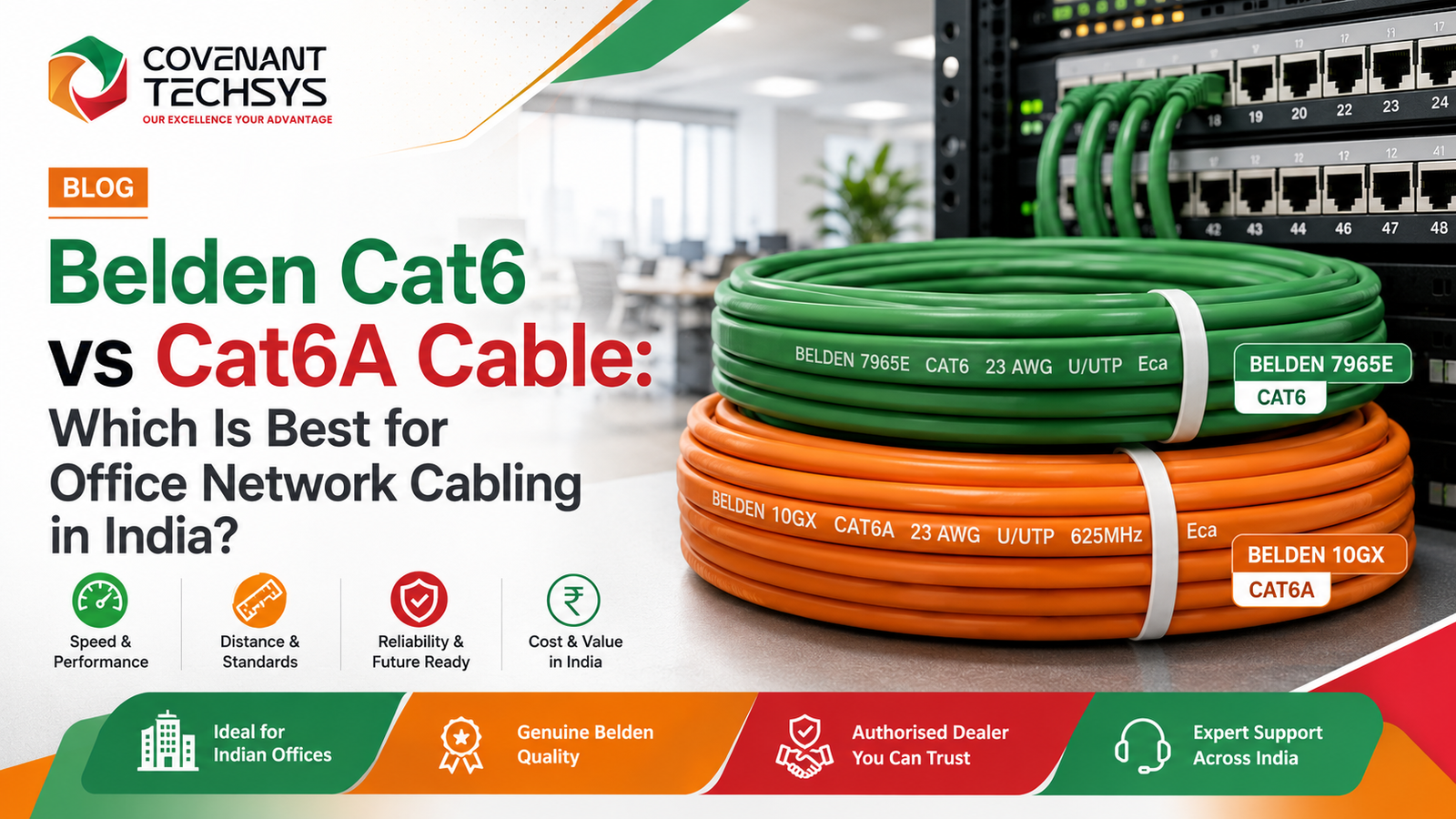
Picking between Belden Cat6 and Cat6A feels simple — until you're standing in front of a 30-rack network room with a tight budget and a 10-year office lease. Get it wrong and you'll either overpay by lakhs or rip the ceiling open again in three years. We've been on both sides of that call as an authorized Belden cable dealer in India, and the answer isn't always "buy the newest one."
This guide breaks down the real differences between Belden 7965E (Cat6) and Belden 10GX (Cat6A) for Indian office cabling, speeds, distance limits, India MRP ranges, installation pain points, and the counterfeit traps that have flooded local markets. By the end, you'll know exactly which cable matches your office.
Key Takeaways
- Cat6 hits 10 Gbps only to 55 meters in clean conditions and drops to 37 meters in tight bundles, per the TIA-568 standard.
- Cat6A delivers full 10 Gbps to 100 meters thanks to its 500 MHz bandwidth and tighter twist design.
- Belden 10GX costs roughly 2x to 3x more than Belden 7965E in India but cuts long-term replacement risk.
- Most small Indian offices (under 50 users) do fine on Cat6. Large offices, data closets, and Wi-Fi 6E uplinks belong on Cat6A.
- Counterfeit Belden is widespread in India — always demand the dealer's distributor invoice and verify the sequential print on the jacket.
Belden Cat6 vs Cat6A at a Glance
Here is the short answer before the deep dive. Cat6 is the value choice for shorter runs and gigabit speeds. Cat6A is the future-ready choice for 10 Gbps, longer pulls, and dense bundles. The price gap is real, but so is the rework cost when a cable doesn't hold up four years later.
| Spec | Belden 7965E (Cat6) | Belden 10GX (Cat6A) |
|---|---|---|
| Bandwidth | 250 MHz | 500–625 MHz |
| Max speed @ 100 m | 1 Gbps | 10 Gbps |
| 10 Gbps distance | Up to 55 m (37 m in bundles) | Full 100 m |
| Shielding | U/UTP (unshielded) | U/UTP, F/UTP or S/FTP |
| Outer diameter | ~5.7 mm | ~7.5–8.2 mm |
| India price (genuine, 305 m box) | ₹35–₹55 per metre | ₹95–₹160 per metre |
| Ideal use | Small offices, gigabit desks | Backbone, 10G uplinks, Wi-Fi 6E |
Source: Belden product datasheets (7965E rev. 0.394, Sept 2025) and TIA-568-C.2 standard. India pricing reflects authorised dealer ranges as of May 2026.
What's the Actual Difference Between Cat6 and Cat6A?
The big number is bandwidth. Cat6 is rated at 250 MHz; Cat6A is rated at 500 MHz — double the headroom for high-speed signaling. That single jump is what lets Cat6A run 10 Gigabit Ethernet across the full 100-meter channel, while Cat6 only manages 10 Gbps up to roughly 55 metres before alien crosstalk wrecks the signal.
What is alien crosstalk in plain English? It's interference that leaks between adjacent cables in a bundle. Cat6 wasn't designed to fight it. Cat6A was. So when you stack 24 Cat6 cables in a cable tray for a 10G run, the spec collapses fast — some lab tests show the safe distance drops to just 37 metres in heavy bundles.
Bandwidth, distance, and what it means for your office
Most Indian office floors in places like Gurgaon's Cyber Hub or Bengaluru's ORR run cable from a central IT room out to the workstations. If your longest cable run is under 50 metres and you're happy with 1 Gigabit per port, Cat6 does the job. If you're building a multi-floor office with Wi-Fi 6E access points, IP cameras, and 10G uplinks to the core switch, Cat6A is the only spec that won't bite you later.
Shielding — do you need it?
Cat6 in the 7965E series is U/UTP, meaning unshielded. Cat6A from Belden comes in three flavours: U/UTP, F/UTP (foil shielded), and S/FTP (braid + foil per pair). Most offices don't need shielded cable. But if you're cabling near lift shafts, large UPS systems, industrial motors, or HT panels, shielded Cat6A keeps the signal clean. Just remember — shielded cables need proper grounding at the patch panel end. Skipped grounding turns the shield into an antenna, which is worse than no shield at all.
Belden 7965E vs Belden 10GX — A Product-Level Comparison
Generic Cat6 vs Cat6A comparisons get you halfway. To actually buy, you need to know the SKUs. Belden's 7965E is its workhorse. Cat6 cable for offices — 23 AWG solid bare copper, U/UTP, PVC jacket, CPR Eca rated. Belden's 10GX is the Cat6A family with multiple variants depending on jacket type, shielding, and fire rating.
Belden 7965E — the office Cat6 default
The 7965E is the cable we sell most often for floors with 30–80 seats running 1 Gigabit. It's a CAT6 (250 MHz), 4-pair, U/UTP cable with 23 AWG solid bare copper conductors, polyethylene insulation, and a PVC jacket — confirmed by the official Belden 7965E datasheet, revision 0.394 dated 9 July 2025. Outer diameter is just 5.7 mm, which makes it easier to pull through Indian conduit and meet bend radius requirements in tight ceiling grids.
It supports 1000BASE-T (Gigabit Ethernet), 100BASE-T, 10BASE-T, FDDI, and ATM applications. It also handles PoE+ comfortably, which matters for cameras and APs. In India, a 305 m reel-in box typically sells between ₹10,500 and ₹16,500—putting the per-meter cost in the ₹35–₹55 band when you buy genuine stock from an authorized dealer.
Belden 10GX — the 10G future-proof pick
The 10GX series steps up to Cat6A territory with 625 MHz bandwidth (above the 500 MHz minimum) and full 10GBASE-T support across 100 meters. Variants include the 10GX12 (U/UTP riser-CMR), 10GX24 (U/UTP LSZH), 10GXS series (enhanced unshielded), and 10GXE (F/UTP and F/FTP shielded). The outer diameter sits between 7.5 mm and 8.2 mm depending on variant — noticeably bulkier than Cat6.
In India, the genuine 10GX 305 m box ranges between ₹29,000 and ₹49,000 based on the dealer, jacket, and shielding, working out to roughly ₹95–₹160 per metre. That's 2x to 3x the cost of 7965E, but you're buying margin for 10 Gbps to the desk, Wi-Fi 7 upgrades down the line, and longer runs in spread-out floor plans.
Which Belden Cable Belongs in Your Office?
This is where most procurement decisions go off the rails. People either over-buy (Cat6A everywhere for a 12-person startup) or under-buy (Cat6 in a 300-seat headquarters with cloud-based design tools). Here's the practical breakdown we walk every client through.
Small offices, under 50 users, 1 Gigabit endpoints
Go with Belden 7965E Cat6. Your switch uplinks are likely 1 Gigabit, your workstations don't need more than 1 Gbps, and your longest cable run from the rack to the far desk is well under 55 metres. Spending Cat6A money here is throwing budget at a problem you don't have. Use that surplus on better switches, a proper UPS, and structured cabling certification.
Mid-size offices, 50–200 users, mixed workloads
This is the grey zone. Our rule of thumb: Cat6 for horizontal runs to user desks and Cat6A for backbone and access point drops. Wi-Fi 6E and Wi-Fi 7 APs can push multi-gigabit throughput; their uplinks deserve Cat6A. Workstation desks doing email, video calls, and SaaS apps will be perfectly served by Cat6 at gigabit speeds.
Large offices, data closets, and 10G uplinks
Default to Belden 10GX Cat6A. If your office has multiple floors, server rooms, or distributed IDF closets, you'll regularly cross the 55-meter Cat6 limit for 10 Gbps. Cat6A keeps you safe for the full 100-meter channel and avoids the awkward "we have to re-pull the riser" conversation in 2030.
Special cases — when shielded Cat6A is non-negotiable
Manufacturing floors near VFDs (variable frequency drives), data centers with hot-aisle/cold-aisle layouts, hospital MRI suites, and offices in high-rise towers running cabling parallel to lift shafts — all need Belden 10GX shielded variants (F/UTP or S/FTP). The grounding cost is real, but the signal integrity is non-negotiable.
Installation Realities Nobody Warns You About
Spec sheets show you the cable. They don't show you what happens when an installer tries to pull a 305 m drum of Cat6A through a 25 mm conduit already half-filled with power cables. Here's what we've learned from years of fitting Belden in Indian offices.
Bend radius and conduit fill
Belden 7965E has a minimum bend radius of about 4x its outer diameter — roughly 23 mm. The 10GX series is stiffer and needs around 8x OD, so a 60–65 mm bend radius is the working figure. That sounds small until you're routing through a false ceiling with HVAC ducts and electrical trays. The standard practice is to fill conduit to no more than 40% of its internal cross-section, per TIA-569 guidance — and Cat6A eats that space twice as fast as Cat6.
Termination time and labour cost
Terminating a Cat6 RJ45 jack on 7965E takes a trained technician 3–4 minutes. The same job on Cat6A — especially shielded variants — can take 7–10 minutes because of the larger conductor gauge, the pair separator spline, and the need to bond the shield to the jack. That doubles your labor bill across a 200-drop project. Factor it in early.
Certification and testing
Don't pay for genuine Belden and then skip certification. A Fluke DSX or Viavi tester confirming each link to ANSI/TIA-568-C.2 (Cat6) or 568-C.2-10 (Cat6A) is the only proof your installer pulled, terminated, and dressed the cable to spec. Keep the test reports — they're useful at insurance renewals and when you eventually re-let the office space.
Counterfeit Belden Is Everywhere — Here's How to Spot It
This is the most uncomfortable section to write, but skipping it would be dishonest. The Indian market is flooded with cables stamped "Belden" that aren't. Some use CCA (copper-clad aluminium) instead of solid copper. Some pass cosmetic checks but fail at 30 metres on a 1 Gbps link. Buyers see the lower price, think they got a deal, and then call us when their network drops packets six months later.
Five quick authenticity checks
Use this checklist before you hand over a purchase order.
- Sequential footage marking — Genuine Belden prints continuous meter markings on the jacket in 1-foot or 1-meter increments. Counterfeits often skip numbers, repeat them, or print uneven spacing.
- Part number on the jacket and box — The jacket should clearly print "7965E" or the matching 10GX SKU. The box should carry a Belden hologram and a unique product identifier (EAN like 8719605016911 for 7965E.01305 in blue).
- Country of origin stamp — Genuine Belden cables are typically manufactured in Hungary (HU), USA, or Mexico (MX). "Made in Hungary" with a Belden Hungary plant code is common for European-distributed reels.
- Conductor test — Strip the jacket and check the conductor. Solid bare copper is reddish-orange throughout. CCA fakes show a silvery aluminum core under a thin copper coating — easy to spot when you cut a fresh end.
- Distributor invoice — Always demand the original Belden distributor invoice from your dealer. Authorized dealers in India can produce this in seconds. If the seller hesitates, walk.
The safest move is to order genuine Belden cables from an authorized Indian dealer who can show you the distributor paperwork and back the supply with a warranty. We've turned away orders ourselves when buyers wanted "cheaper "Belden"—there is no such thing.
Cabling Is Just One Piece of Your Network Stack
The cable carries the signal, but it's only as good as the gear on either end. A Cat6A run wasted on a 1 Gigabit switch is just expensive Cat6. We typically pair Belden runs with managed switches, structured cabling design, and proper power conditioning — because a network is a system, not a parts list.
If you're planning the whole stack from scratch, our complete networking & wireless solutions bundle covers cabling, switches, access points, and configuration. To secure your network infrastructure against the threats that come with always-on connectivity, the network security service adds firewalls, segmentation, and policy controls on top of clean cabling.
Need the wider picture? For a deeper read on cabling design itself, see our structured cabling services overview, or browse our full service catalog to see how the pieces fit together for Indian offices.
If your office runs gigabit, sits on one or two floors, and has cable runs under 55 meters, Belden 7965E Cat6 is the smart, cost-effective choice. If you're building for 10 Gbps, Wi-Fi 6E or 7, longer runs, or you simply want to pull cable once and forget about it for the next decade, Belden 10GX Cat6A pays for itself in avoided rework.
The one thing both choices share — they only work if the cable is genuine and the installation is certified. That's the part most buyers in India underweight. Get the cable right, get the installer right, and the network will quietly do its job for years.
Planning a new office cabling project or replacing aging cable? Talk to our team for a free site assessment and genuine Belden quote.