

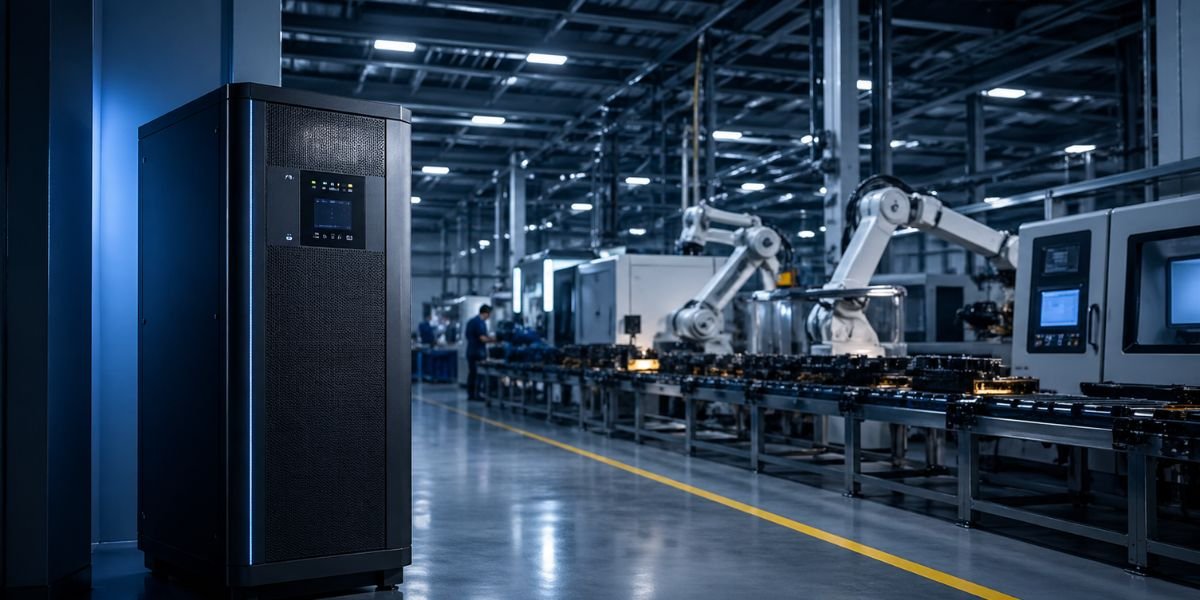
Power cuts don't just flicker the lights — they halt production lines, corrupt critical data, and damage expensive equipment. For industries where every second of uptime translates directly to revenue and safety, a standard UPS simply isn't enough. Fuji Online UPS systems are engineered for exactly these environments: high-demand, always-on operations that can't afford even a brief interruption. If your facility runs around the clock, understanding which industries benefit most from this technology and why is a conversation worth having.
Why Continuous Power Matters in Industrial Operations
Ask any plant manager who has dealt with an unplanned shutdown, and they'll tell you the same thing: the cost isn't just the lost hours. It's the cascade of problems that follows.
A sudden power failure in a manufacturing facility can jam automated machinery mid-cycle, triggering costly recalibration and repairs. In a data center, even a millisecond gap in power supply can corrupt active transactions and bring down entire server clusters. Healthcare environments face an even more serious consequence: life-critical equipment losing power at the wrong moment is simply unacceptable.
Beyond the immediate damage, power instability—voltage spikes, sags, and harmonics—quietly degrades industrial equipment over time. Motors burn out faster. Control boards fail prematurely. Maintenance costs creep up quarter after quarter.
This is why the conversation around industrial power backup solutions is shifting from "nice to have" to "non-negotiable" for serious operations.
What Makes Fuji Online UPS Suitable for Industrial Use
Not all UPS systems are built the same. The "online" designation is significant: a true online UPS keeps your equipment running on clean, conditioned power at all times — not just when the grid fails. The battery isn't a fallback; it's continuously in the circuit.
This means zero transfer time during a power event. There's no switching delay, no micro-gap, no momentary flicker. For sensitive industrial electronics and IT systems, that distinction matters enormously.
Fuji Online UPS units are known for their reliable performance in demanding environments, handling fluctuating loads, tolerating harsh ambient conditions, and delivering stable output voltage regardless of what the incoming supply looks like. They're also designed with scalability in mind, which is essential for facilities that expect their power requirements to grow over time.
As a trusted Fuji Online UPS dealer in India, Covenant Tech Systems works with facilities across sectors to identify the right configuration for their operational requirements.
Industries That Should Use Fuji Online UPS
Manufacturing Plants
Modern manufacturing runs on automation. CNC machines, robotic arms, conveyor systems, and PLC-controlled processes are all deeply sensitive to power irregularities. A sudden outage mid-run doesn't just pause production; it can destroy work in progress, jam equipment, and require hours of recalibration before the line is operational again.
Beyond outages, voltage instability causes subtle, cumulative damage to motor drives and control systems. An online UPS eliminates this problem entirely by isolating connected equipment from the grid and supplying consistently regulated power.
For factories running two or three shifts, the math on downtime costs is stark. Even a single hour of unplanned stoppage can outweigh months of UPS operating costs.
Data Centers & IT Infrastructure
Data centers have zero tolerance for power interruptions. A brief outage doesn't just bring servers offline; it can corrupt databases, damage storage arrays, and trigger chain failures across interconnected systems. Recovery time can stretch from hours to days, depending on the architecture.
An online UPS provides the seamless power continuity that IT infrastructure demands. Combined with proper load management and redundant configurations, it forms the backbone of any serious data protection strategy.
Cloud hosting providers, co-location facilities, and enterprise IT teams managing on-premise infrastructure all rely on this level of protection.
Healthcare Facilities
In a hospital or diagnostic centre, power failure isn't an inconvenience; it's a patient safety issue. ICU monitors, ventilators, surgical lights, imaging equipment, and blood bank refrigeration all require uninterrupted power, regardless of what's happening on the grid.
While hospitals typically have diesel generators for extended outages, generators take 10–15 seconds to come online. An online UPS bridges that gap without any interruption whatsoever, ensuring no equipment loses power even for an instant during grid failure.
Smaller clinics and diagnostic labs face similar risks and often lack the infrastructure of large hospitals, making a reliable online UPS even more critical in those settings.
Commercial Buildings & Offices
Large commercial properties, office complexes, malls, and hotels depend on power for more than just lights and computers. Elevators, access control systems, fire suppression panels, surveillance networks, and HVAC controls all need to stay online during grid disruptions.
A power failure in a busy office building or hotel can be a serious liability. Elevators stuck between floors, security systems going dark, and payment terminals going offline are all real-world consequences of inadequate power backup.
Online UPS systems are increasingly being specified in building management plans for commercial properties that want to maintain operations and safety standards regardless of grid conditions.
Telecom & Network Operations
Telecom infrastructure runs 24/7 by definition. Cell towers, switching stations, network operation centers, and ISP hubs cannot tolerate power interruptions. Even a brief outage can drop thousands of active connections and compromise network-level services.
Battery backup in telecom has always been standard practice, but the move to online UPS configurations has allowed operators to also address power quality issues — harmonics, transients, and frequency instability — that degrade sensitive networking hardware over time.
For businesses operating private network infrastructure or edge computing nodes, the same logic applies.
Key Benefits of Using Fuji Online UPS in These Industries
Across all these sectors, the operational benefits follow a consistent pattern:
- Stable, conditioned power output — eliminates voltage spikes, sags, and harmonic distortion before they reach connected equipment
- Zero transfer time — no gap between grid power and battery, critical for sensitive electronics and automated systems
- Reduced unplanned downtime — protects against grid failures and load fluctuations that would otherwise halt operations
- Extended equipment lifespan — clean power reduces wear on motors, drives, and control boards
- Operational continuity — keeps business-critical processes running through power events without manual intervention
For facilities exploring industrial power backup solutions, these benefits collectively translate into measurable ROI — both in avoided losses and reduced maintenance costs.
Choosing the Right UPS for Your Industry
Selecting a UPS isn't a one-size-fits-all decision. A few key factors determine what configuration makes sense for a given facility:
Load requirement: Calculate the total power consumption of critical equipment that needs protection. Your UPS capacity should comfortably cover peak load, not just average draw.
Environment: Industrial environments often involve elevated temperatures, dust, humidity, or vibration. Make sure the unit you choose is rated for your specific operating conditions.
Autonomy time: How long does your facility need to run on battery during an outage? This determines battery bank size. Some operations need 10 minutes to trigger a safe shutdown; others need several hours of runtime.
Scalability: If your operations are growing, look for modular UPS configurations that allow you to add capacity without replacing the core unit.
Maintenance access: In 24/7 environments, hot-swappable batteries and modular designs reduce maintenance downtime significantly.
Getting this specification right from the start saves money and prevents undersized systems from failing under real-world load. Working with an experienced Fuji Online UPS dealer in India ensures you get a solution that's properly sized and supported for your application.
Conclusion
Power protection isn't a luxury reserved for the largest enterprises. Any facility where downtime carries a real cost — financial, operational, or human — has a strong case for investing in a reliable online UPS system.
Manufacturing plants, data centers, hospitals, commercial buildings, and telecom operators all share a common vulnerability: their operations assume power will always be there. An online UPS doesn't just protect against the worst-case scenario; it actively improves power quality day in and day out.
If you're assessing power protection options for your facility, it's worth consulting with a specialist who understands both the technology and the specific demands of your industry. The right system, properly configured and maintained, pays for itself — often faster than most decision-makers expect.